What jobs actually cost around Easley and the county
Drive ten minutes outside Easley in any direction and you are on wooded ground that tilts — loblolly pines climbing above rooflines, water oaks spreading over driveways, all of it rooted in the red clay and rocky soil of the Blue Ridge foothills. National cost guides are built from suburban flatland data, and they do not account for the climbing, rigging, and controlled lowering that a sloped Pickens County lot routinely demands. The range below reflects what this terrain actually produces.
| Scope of work | Typical Upstate SC range | What drives it |
|---|---|---|
| Small tree, good ground access | $250 – $450 | trunk diameter, branch count, debris volume |
| Medium hardwood or pine (30–50 ft) | $375 – $650 | height, canopy spread, ground access |
| Tall tree, 60 ft or more | $600 – $900 | climber time, rigging, lowering cuts |
| Any tree over a roofline or utility lines | toward $900 | risk rating, piece-by-piece lowering required |
| Multiple trees, same visit | lower per-tree rate | mobilization and setup cost shared across the job |
These are honest working ranges for the Upstate, not quotes. A crew that gives you a firm number before seeing how the lot slopes and where the debris will land has priced a generic job, not yours. Tree Wisemen provides free on-site estimates within 50 miles of Easley — the tree trimming service page explains what a full site visit covers and what to expect from a written scope.
What the foothills terrain does to the job
Pickens County occupies the transition between the South Carolina Piedmont and the Blue Ridge foothills — terrain that affects tree care the same way it affects roofing, grading, and drainage work: slope makes everything cost more. Properties near Table Rock State Park, along the Lake Keowee shoreline, and in older neighborhoods around the town of Pickens share the same character: mature trees, significant grade change, and canopies that have grown into structures over decades without intervention.
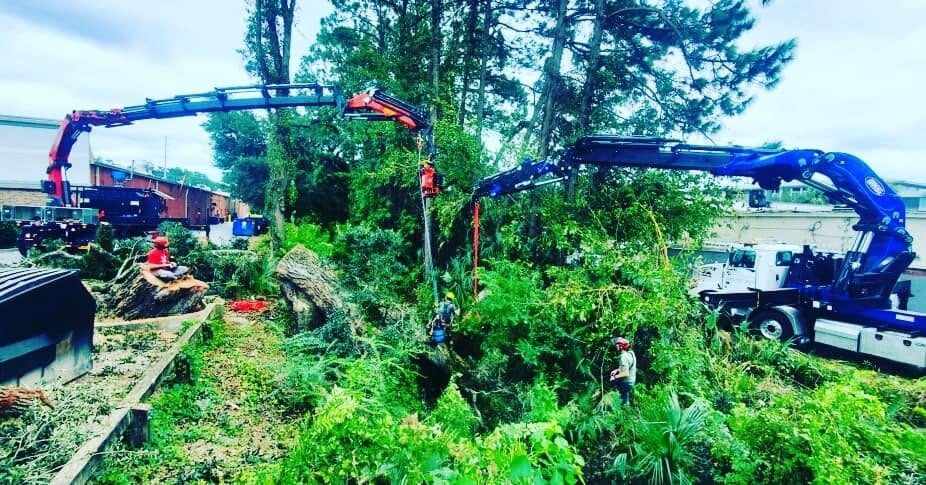
The regional tree mix amplifies the problem. Loblolly pine grows fast in this climate — fast enough that a pine present at a home's construction can push 60 feet or taller within 20 years and position a heavy canopy directly over a roofline. That is the scenario that makes limbs over the roof a real line item in most Pickens County estimates rather than an occasional upsell: every cut above a structure has to be rigged, controlled, and lowered by hand rather than dropped to the ground. Hardwoods like water oak and sweetgum grow more slowly but build wide canopies that create their own access complications on a narrow or sloped lot.
The SC Forestry Commission specifically recommends regular crown maintenance to reduce the risk of storm-related limb failure — guidance shaped by real weather exposure in this region. A proactive trim that removes structurally weak or crossing limbs runs a fraction of the emergency call that follows a limb through a roofline.
Storm history and what it means for maintenance timing
The Upstate's weather record makes the financial case for proactive care plainly. This region has seen 23 federally declared disaster events over 2005-2026, most of them tied to severe storms. The specific hazard that separates the foothills from coastal South Carolina is ice loading: a moderate ice event deposits enough weight on a full pine or hardwood canopy to split structurally compromised branch unions and bring limbs down without any wind involved. That failure mode targets exactly the positions that routine pruning addresses — tight branch forks with included bark, deadwood sitting inside a dense crown, long horizontal limbs extending over a structure.
Clemson Cooperative Extension publishes South Carolina-specific guidance on structural pruning — when to cut, which limbs to target, and how to read the warning signs that separate a tree worth maintaining from one that has crossed into removal territory. That science is what a trained arborist applies during a site visit; it is not something a general yard-maintenance crew brings to the job.
When a tree has moved past the point where trimming resolves the risk, the tree removal cost guide covers what that decision typically runs in the Upstate and which variables move the number.
What credentials to ask for before anyone climbs a tree on your property
Tree care in South Carolina does not sit under a single dedicated license the way electrical or HVAC work does, which means the market is not filtered the way licensed trades are. The credential most worth requesting is ISA Certified Arborist standing — issued by the International Society of Arboriculture, requiring documented knowledge and ongoing continuing education, and verifiable through the ISA's public directory. It is not a legal requirement, but it is the professional standard that separates trained climbing arborists from general labor with a chainsaw.
For larger projects with structural components — cable bracing anchored to a building, support work tied into a foundation — verify whether general contracting licensure applies. The SC LLR Contractor Licensing Board governs that threshold in South Carolina, and an experienced contractor will know where the line sits on a job of your scope.
If any part of the work involves pesticide or herbicide application — bark beetle treatment, stump herbicide, any injection or spray — the applicator must hold a license under the Clemson Department of Pesticide Regulation, South Carolina's lead agency for pesticide applicator certification. Ask for that credential before any chemical is opened on your property. South Carolina does not require a building permit for routine residential tree trimming. Work that physically ties into a structure changes that calculation; a quick check with Pickens County's building office settles the question before work begins.
How to hold an estimate together from first call to final cleanup
Three practices protect Pickens County homeowners in this market:
- Require a site visit before any number. Slope, canopy position relative to the structure, soil conditions, and debris drop zones all affect what the job actually takes. A quote given over the phone is built from assumptions about a lot the crew has not seen.
- Get explicit clarity on over-structure limbs. Ask specifically whether any limbs are priced as over-roof or over-utility work. The difference between standard drop-zone trimming and rigged, lowered piece-work shows up in the final number, and knowing upfront prevents a mid-job conversation about scope.
- Measure bids against the Upstate range. If a bid for a 60-foot pine comes in significantly below the ranges in the table above, ask how the rigging time is accounted for. Sometimes there is a real explanation — the crew is already staging equipment in the neighborhood. How they answer tells you more about how they run jobs than any marketing claim does.
The table in the first section gives you a working benchmark for the Upstate. A quote well outside it in either direction deserves a plain explanation before any paperwork is signed.