Pines past rooftop height in Anderson's older grid
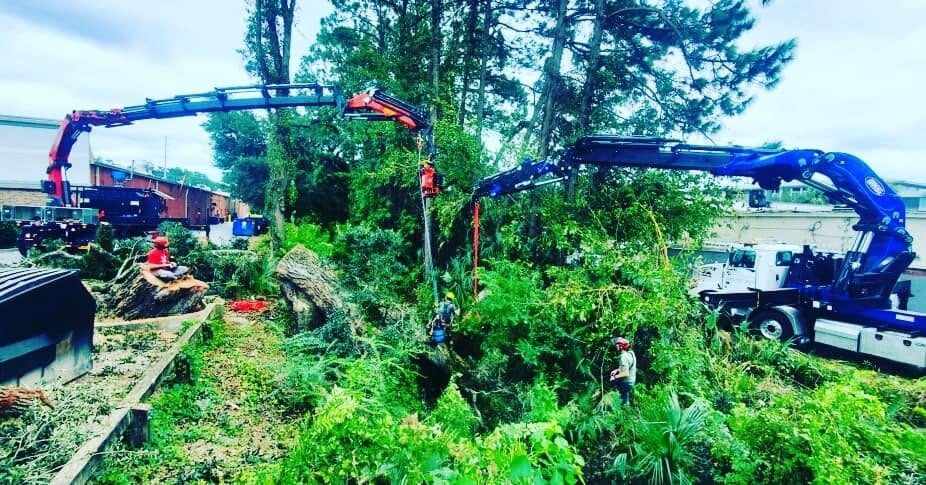
Anderson's mid-century residential grid grew up alongside its trees. The neighborhoods that filled in from the 1950s through the 1970s — blocks radiating out from the city center, older subdivisions spread east and north — were planted generously when houses were small and lots were clear. Those loblolly pines are now 60 to 80 feet tall. The water oaks have canopied over driveways and rooflines. Unlike an open rural lot or a newer subdivision, most removal jobs inside the city of Anderson are tight-drop operations: top-down, piece by piece, with a crew controlling each section from above a structure rather than standing clear of it.
Piedmont red clay soil shapes the job further. Loblolly pines in clay root shallow and wide; the root plate lifts from the soil during wind events rather than snapping deep in the trunk. Sweetgums develop aggressive surface roots that work under driveways and concrete over time. These are not abstract concerns — they determine how a crew assesses stability before the first cut. The tree removal service page covers how the job type and equipment change from lot to lot.
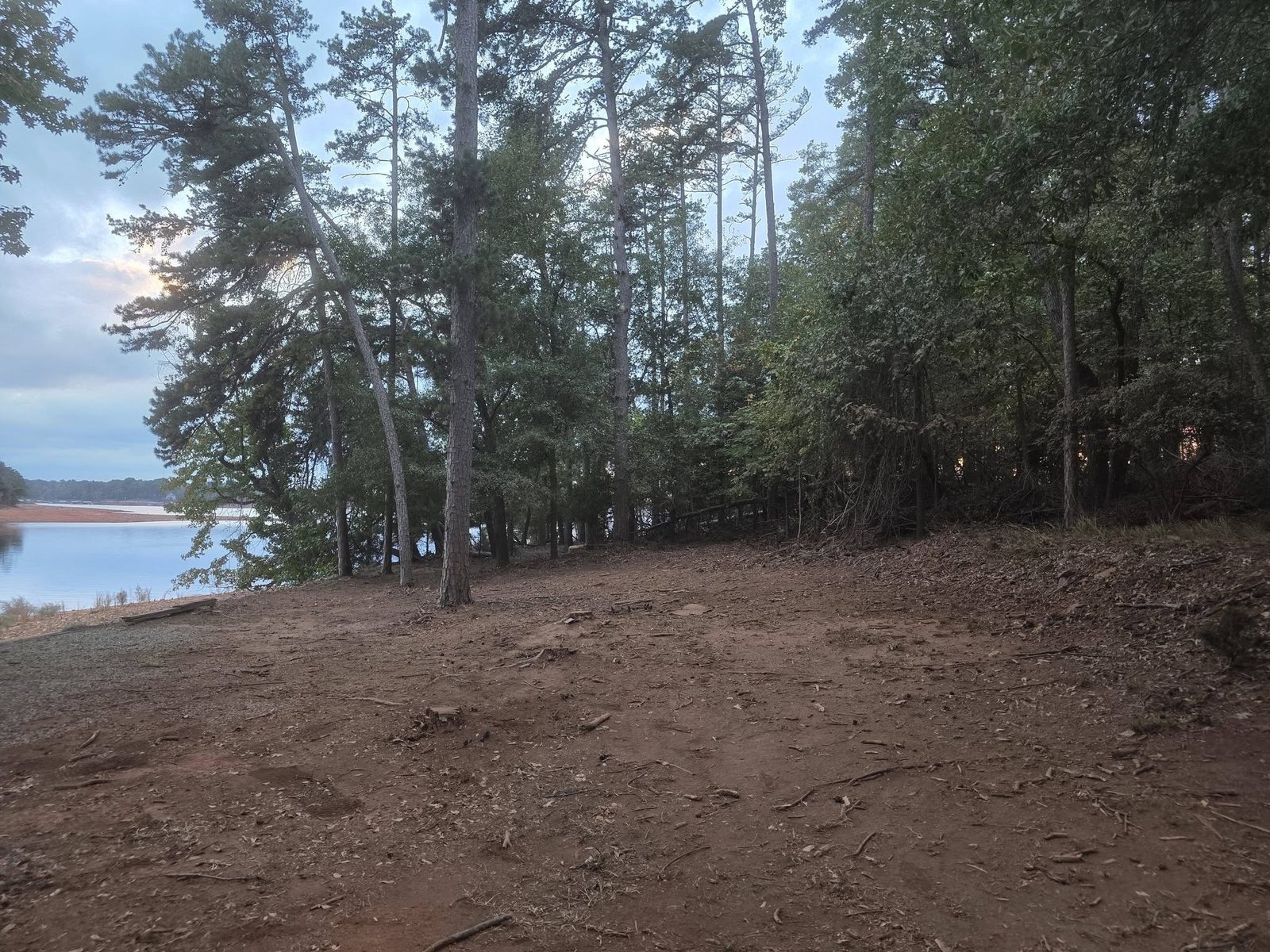
Lake Hartwell's waterfront properties along Anderson County's western edge add a separate dimension: slope access, root systems near the water line, and canopy positions that require equipment reach available from only one narrow lane. Those jobs price at the top of their size category for exactly that reason.
What tree removal costs in Anderson County
Across Anderson County, most residential tree removal lands between $300 and $2,000 per tree. Where a job falls in that range depends on tree height, species, the drop zone, and whether the tree is structurally sound or compromised. The table below shows typical ranges for the Anderson area:
| Job scope | Typical Anderson range |
|---|---|
| Small tree (under 25 ft) | $300 – $500 |
| Medium tree (25–50 ft) | $500 – $1,000 |
| Large tree (50–75 ft) | $1,000 – $2,000 |
| Hazardous removal (over structure or tight drop) | $1,500 – $3,000 |
| Multi-tree lot clearing (per tree, 3+ trees) | $300 – $700 |
These are typical market ranges for the area, not quotes. Tree Wisemen prices every job after a free on-site estimate. For a full line-item walkthrough — what access fees, wood disposal, and crane requirements add to the base figure — see the tree removal cost guide. Stump grinding is a separate service; stump grinding pricing for Anderson County is covered there.
Storm damage and Anderson County's weather record
Upstate South Carolina sits in a storm corridor that earns its federal disaster record. Anderson County has accumulated 18 declared events across 2005-2026, most of them severe thunderstorm and flooding events. These storms knock trees over, split major scaffold branches, and — the scenario most often underestimated — leave pines standing with compromised root systems that hold until the next saturated-soil event tips them. The SC Forestry Commission publishes post-storm hazard assessment guidance for this situation: a tree that survived a storm with significant crown loss or an exposed root plate is a materially different risk than a healthy standing tree and should be evaluated as one before the next weather cycle arrives.
Two post-storm patterns that Anderson homeowners misjudge most often: a leaning pine that seems stable after wind is usually extracting from its root plate with every rain that follows, and it does not self-correct. A large dead branch suspended in the crown that survived the storm intact is a service call, not a full removal, and removing it before gravity makes the scheduling decision is the right sequence. Storm-damage jobs flagged on the estimate request receive priority scheduling.
Hiring a tree crew in Anderson — what to verify first
SC contractor licensing governs residential specialty work once a tree job crosses applicable thresholds — the SC LLR Contractor Licensing Board sets those requirements. For jobs that involve herbicide application to stumps or root systems after removal, pesticide applicator licensing is a separate requirement administered through Clemson's Department of Pesticide Regulation. A crew applying chemical treatment without that credential creates an exposure for the homeowner, not just the contractor.
Three Anderson-specific checks before signing: ask whether the crew has worked tight-drop removals over structures in older Piedmont neighborhoods — open-lot felling and controlled piecework over a roof are different operations, and references on one do not carry over to the other. Ask for proof of both general liability and workers' compensation coverage; a tree through a roof during removal is a scenario where that distinction matters immediately. And ask whether stump grinding is included in the quote or priced separately. It almost always runs separately, and knowing the complete number before work starts prevents the most common post-job surprise.
What grows in Anderson County and how it fails
Anderson County's residential canopy is dominated by loblolly pine, water oak, willow oak, sweetgum, and — in the county's older sections — white oak specimens that have held through decades of Upstate weather. Each species ages and fails differently. Clemson Cooperative Extension's Home and Garden Information Center publishes tree selection and care guides specific to the Upstate SC climate, useful context when deciding what replaces a removed tree.
Loblolly pines are the most common emergency call in Anderson County: fast-growing and shallow-rooted in red clay, they fail at the root plate during saturated soil events rather than snapping mid-trunk. Water oaks are the most underestimated species on the list — healthy from the outside, often hollow from internal decay that is not visible until a failure exposes it. Sweetgums are the most likely to have aggressive surface roots that have worked under a driveway or lifted concrete slabs over time, pairing the tree removal with a hardscape repair conversation.
Late winter through early spring, before full leaf-out, is the easiest window for assessing structure and planning cleanup. Neither window applies to safety-driven work — a hazardous tree comes down when the assessment says it should, regardless of season.