How Pickens County hardwoods grow into rooflines
Pickens County sits at the base of the Blue Ridge, and the foothills growing season runs long and wet. Tulip poplars, white oaks, and water oaks — the dominant hardwoods in this part of Upstate South Carolina — can add two to three feet of vertical height in a good year. On the slope lots common throughout the county, a tree planted at grade a decade ago may now top the roofline and extend horizontally across a low-pitched asphalt roof. Coastal SC trees grow in flat terrain where canopy spreads evenly; Upstate trees on a grade naturally angle new growth toward the nearest structure, which is often the house.
The signs that action is overdue: limbs that visibly rest on or sag toward the roof deck, shingle granule deposits collecting in gutters directly below the canopy, and branches thick enough to cause structural damage if a stem connection failed. When a limb is already in contact, the problem is active, not potential. When one sits two feet away, it may close that gap before the next storm season.
What contact does to shingles and flashing
Direct contact between a tree limb and a roof deck is slow-motion damage. Every time wind moves the canopy, bark and branch rub against asphalt shingles and abrade the granule surface — the weather-shedding layer built into the product. Lose enough granules in one zone and water begins finding the deck underneath, especially at valleys and around chimney flashing where it already concentrates. The debris load matters too: a canopy over the roof keeps organic material banked against flashings and in gutters year-round, not just in fall. That continuous moisture exposure accelerates shingle degradation on a schedule most warranties do not cover.
If the limb in question is also near service equipment on the structure, the risk picture changes considerably. See our guide on tree near power lines for how those jobs are scoped differently and why they require separate planning.
Storm exposure in Upstate SC
Pickens County appears in the federal disaster record 23 times over 2005-2026, the majority storm-family events. That frequency reflects where the county sits: the Upstate lies along a corridor where Gulf moisture pushes against the foothills, and spring thunderstorm systems here regularly produce localized downbursts. The NOAA National Weather Service storm archive for the Upstate confirms meaningfully higher wind-damage event rates here than in the state's coastal and midlands counties.
What that means practically: a 50 mph downburst gust can flex a mature hardwood limb two feet or more. The clearance measured in calm conditions is not the clearance that exists during the storm. Limbs that look safe on a dry afternoon can become the lever that breaks flashing or displaces ridge cap. The Clemson Cooperative Extension publishes guidance on identifying structurally weak limb attachments — worth reviewing before assessing a mature oak or poplar yourself.
Scope and typical cost for this work
What you pay depends on how far the limbs extend over the deck, how high the canopy sits, what species and stem diameter you are working with, and whether slope-lot terrain requires special positioning. The figures below reflect typical Upstate SC ranges; Tree Wisemen prices every job after a free on-site estimate. For the full service breakdown, see the tree trimming cost guide.
| Scope | Typical Range | What moves the number |
|---|---|---|
| 1–2 limbs removed, accessible tree | $250–$400 | Limb diameter, drop zone clearance |
| Canopy trim, standard-height tree | $350–$600 | Number of limbs, species growth rate |
| Tall hardwood over roof (oak, poplar) | $500–$900 | Tree height, slope-lot access, limb count |
| Full clearance, slope-lot property | $600–$900 | Terrain complexity, canopy spread |
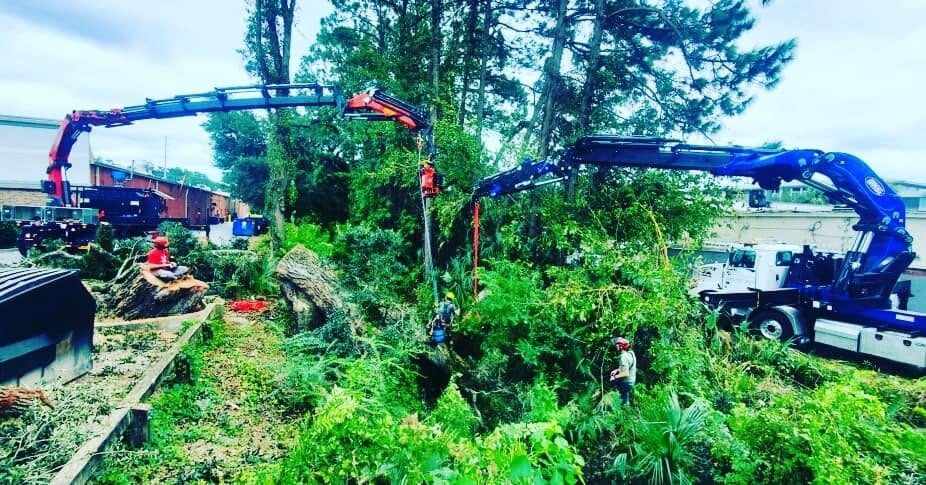
Jobs that expand to full removal, crane access, or utility coordination fall outside the trimming scope in this table and are priced separately after on-site assessment. See the tree trimming overview for how clearance-only work differs from removal.
What to ask before the crew starts
Tree work in South Carolina falls under contractor licensing rules administered by the SC LLR Contractor Licensing Board. Ask for license verification on any job that involves climbing equipment, bucket trucks, or rigging to control limb direction over a structure. A crew that hesitates on that question is not the crew you want controlling a limb over your roof.
Three Pickens County checks worth making: ask whether the crew has worked slope-lot properties and knows how to position for a controlled drop on grade; ask how they protect the roof deck and gutters during the job, since branch contact during the work can cause the same damage you hired them to prevent; and ask what the finished canopy will look like. A proper clearance trim leaves the remaining canopy balanced, not just shortened. An unbalanced cut creates new overhang on a shorter timeline than the original growth did. Use this page's form to describe your tree and roofline so your free estimate is scoped correctly from the first visit.