How the foothills terrain changes this problem
Pickens County occupies the eastern edge of the Blue Ridge escarpment — terrain where residential lots slope, hardwoods grow tall, and utility lines run through corridors that were forested long before the houses arrived. White oaks, tulip poplars, and shagbark hickories routinely top 70 to 90 feet here, and they did not stop growing after Duke Energy strung wire through the canopy. What makes a tree near power lines more complicated in the foothills than on the flat Piedmont is elevation: a tree rooted 15 feet below a utility pole on a hillside lot can reach the same conductor height with a trunk that appears nowhere near the pole. Horizontal distance is misleading when the terrain tilts.
That slope geometry is why homeowners in this part of upstate South Carolina routinely discover that work they assumed was "on their property, away from the lines" is actually inside the utility's minimum approach corridor. Two overlapping authorities govern what can happen: Duke Energy's vegetation management program, which controls activity within their right-of-way regardless of whose land the roots are on, and the state contractor-licensing framework enforced by the SC LLR Contractor Licensing Board, which governs who can legally do tree work for hire. Miss either one and you are either unauthorized to touch the work or working without the liability cover you would need if something goes wrong.
If a tree has already begun leaning toward a span — common on steeper lots after a wet season softens the soil — a leaning tree assessment belongs before any conversation about line clearance. The question is whether the tree has a structural defect driving the lean or whether it is simply growing toward light. That answer changes the work sequence entirely.
What is and is not permitted — the plain rule matrix
The clearest way to understand what a homeowner can legally do is to map the work against the two controlling authorities: OSHA's minimum approach distance (10 feet from energized distribution lines for unqualified persons) and Duke Energy's right-of-way boundary. That 10-foot number is not advisory. It applies to a homeowner with a pruning pole as much as it does to any worker on a job site, and it covers the swing arc of a limb being cut, not just where you are standing.
| Work | Who Controls It | Authorization Required? |
|---|---|---|
| Pruning branches with no proximity to lines | Property owner or licensed arborist | No permit; SC contractor license required if hired out |
| Any work within 10 feet of energized lines | Utility-qualified line-clearance crew only | Duke Energy authorization required before work begins |
| Trimming or removal inside the utility easement | Duke Energy vegetation management program | Notify Duke Energy; they may perform at no charge |
| Emergency removal after a tree contacts a live wire | Utility first, then licensed arborist | Call Duke Energy before anyone approaches the tree |
| Removal of a tree that could strike lines during felling | Licensed arborist with line-clearance qualification | Notify utility of planned work before any cuts are made |
| Herbicide to stumps or brush inside the utility corridor | Licensed pesticide applicator | SC applicator license through Clemson DPR required |
Who can legally do the work in South Carolina
For tree removal or significant trimming on your property that does not involve line proximity, South Carolina requires that anyone doing the work for hire hold a valid contractor's license issued by the SC LLR Contractor Licensing Board. Unlicensed tree workers are persistent in upstate South Carolina, especially in the weeks after a major storm. The lower bid often reflects no license and no insurance — liability that transfers to the property owner if something goes wrong during the job.
The more specific credential for work near energized lines is line-clearance tree trimmer qualification, which follows OSHA standards 1910.269 and 1926.950 for minimum approach distances and personal protective equipment. An ISA-certified arborist is not automatically line-clearance qualified; those are separate training tracks. Before any company opens a saw within reach of a span wire on your property, ask directly whether the crew holds line-clearance certification. A licensed tree company without that credential cannot legally do that specific work.
Routine tree trimming well away from utility lines sits in a different category: a licensed arborist is the right call for climbing, significant crown work, or large-diameter limbs, but line-clearance qualification is not required unless the work puts a person or a falling limb within the OSHA minimum approach distance. The SC Forestry Commission maintains guidance on forest management practices in South Carolina, including tree assessment resources relevant to utility corridors and storm-damaged timber — useful when you are deciding whether a tree needs removal or structural pruning before it reaches the lines.
Where Duke Energy's authority ends and yours begins
Duke Energy holds vegetation management easements along its distribution and transmission lines throughout Pickens County. Within those easements — which extend a specified distance on each side of the conductors, not simply beneath them — the utility has the legal right to trim or remove trees that threaten reliability or public safety. They exercise this right on their own schedule through their own contractors. Homeowners sometimes discover that a tree has been significantly limbed without prior coordination; that is legal, and it is a function of the easement agreement attached to the property deed.
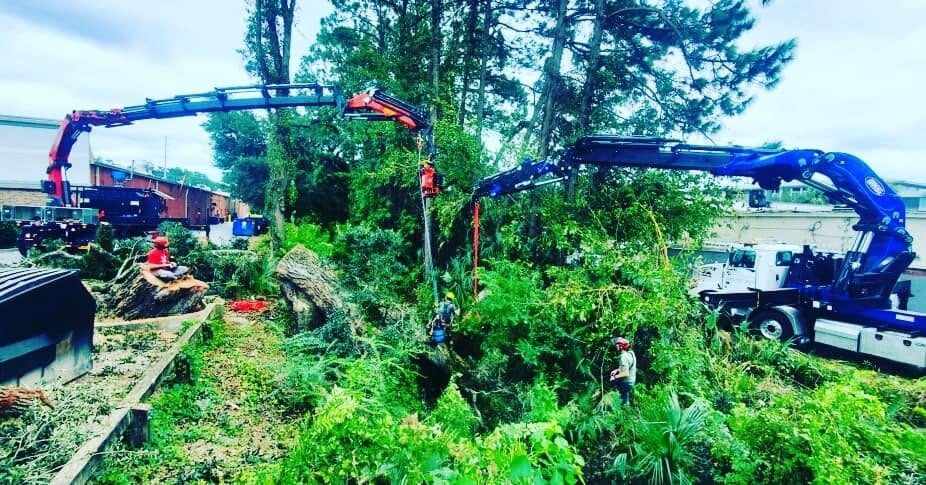
What Duke Energy's program does not cover is a hazard tree outside their easement that is growing toward the corridor. That tree is your responsibility until it crosses into the right-of-way. A planned removal of a hazard hardwood in the foothills — large-diameter trunk, slope access, working near but outside the utility corridor — typically runs $500–$1,500 depending on size, species, and terrain. A reactive call after the tree has already contacted a line is a different equation: the utility's restoration crew handles the conductor, your contractor handles the wood, and costs and liability are uncontrolled. For how those after-hours calls work and what to expect, see the emergency tree service page.
If you believe a tree inside Duke Energy's easement poses an immediate hazard, report it through their vegetation concern process. That report starts the clock on their response timeline rather than leaving you to decide unilaterally whether to act — an important distinction if the tree later causes an outage or injury.
When a storm forces the issue before you planned for it
The foothills of the Blue Ridge sit in a storm corridor that sees severe thunderstorms, ice accumulation events, and occasional tropical remnants tracking inland from the coast. Pickens County has been included in federal disaster declarations 23 times over 2005-2026, covering wind and flooding events that bring mature hardwoods into utility corridors faster than any scheduled trimming program can anticipate. When a tree comes down on a span, the sequence is non-negotiable: call 911 if there is immediate danger to people, then call Duke Energy's outage line before anyone approaches the downed tree or the wood around it. A wire that appears dead can re-energize without warning.
After the utility has de-energized the line or confirmed the conductor is safe, a licensed tree contractor can complete the removal and site work. The SC Forestry Commission publishes post-storm guidance for property owners managing multiple downed trees — practical reference when you are assessing a property where the storm hit everything at once. Storm aftermath is also when unlicensed crews operate most aggressively in upstate SC, pricing below market because their overhead is zero; the hidden cost is the liability transfer to the homeowner when no license and no insurance back up the work.
For advance planning rather than reaction, Clemson Cooperative Extension's Home and Garden Information Center has practical guidance on tree species selection and placement near structures and utility lines. The right species in the right location, chosen before a sapling becomes a problem, is the cheapest line-clearance solution in the entire decision tree.