Foothills soil is why whole trees fail here, not just drop limbs
Pickens County sits where the South Carolina Piedmont meets the lower Blue Ridge foothills — a transition zone where red clay gives way to decomposed granite and shallow rocky subsoil within the first few feet. Tulip poplars, water oaks, and red maples grow fast in that profile, putting up impressive height on a root plate that never anchors the way deep flatland clay allows. When a summer squall line or a winter ice event loads those canopies, whole-tree failures are common. Emergency calls in this part of the state tend to involve trees fully across a yard, driveway, or roof rather than a single limb a homeowner could manage on their own.
Pickens County has been included in 23 federal disaster declarations spanning 2005-2026, a large share of them tied to wind and ice events that arrive from the mountains with limited lead time. The NOAA National Weather Service Greenville-Spartanburg forecast office issues foothills-specific watches that carry real weight on a mature hardwood lot in Easley or Liberty — more so than the coastal storm advisories that dominate statewide coverage. If a tree has just come down, distance from anything still moving is the right answer while you wait for the crew.
What happens from first call to finished job
A 24-hour emergency call moves differently than a scheduled removal. Expect this sequence:
- Hazard triage on arrival. The crew walks the site before touching anything — reading secondary lean, checking for utility contact, and assessing whether the root plate is still settling. A tree that came down an hour ago may still be shifting.
- Utility coordination if needed. Live power line contact is not a tree crew's scope to clear. If lines are involved, the crew coordinates with the utility before work begins. This is not optional and is not negotiable at the job site.
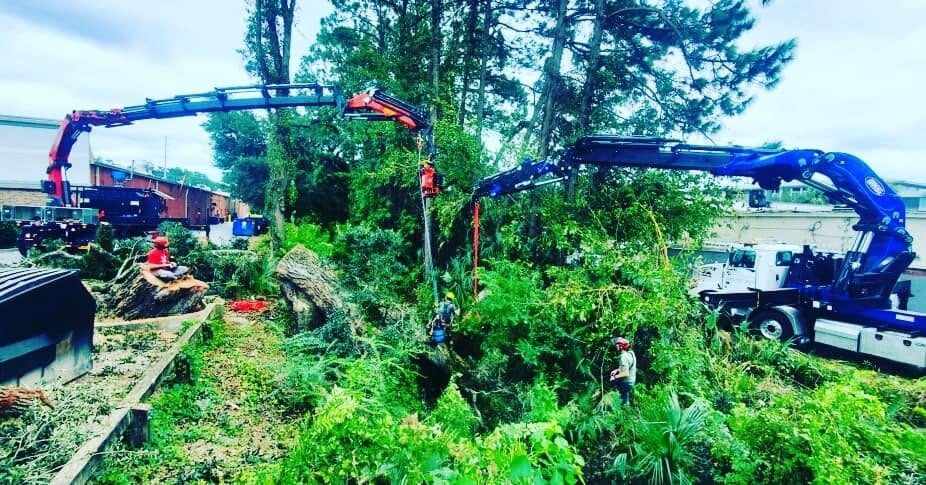
- Controlled sectional cutting. On slope lots and tight residential access, trees are worked in sections from the top down rather than felled as a whole. This takes longer than a flat-lot drop — one reason on-grade emergency work in the Upstate runs higher than lowcountry comparisons suggest.
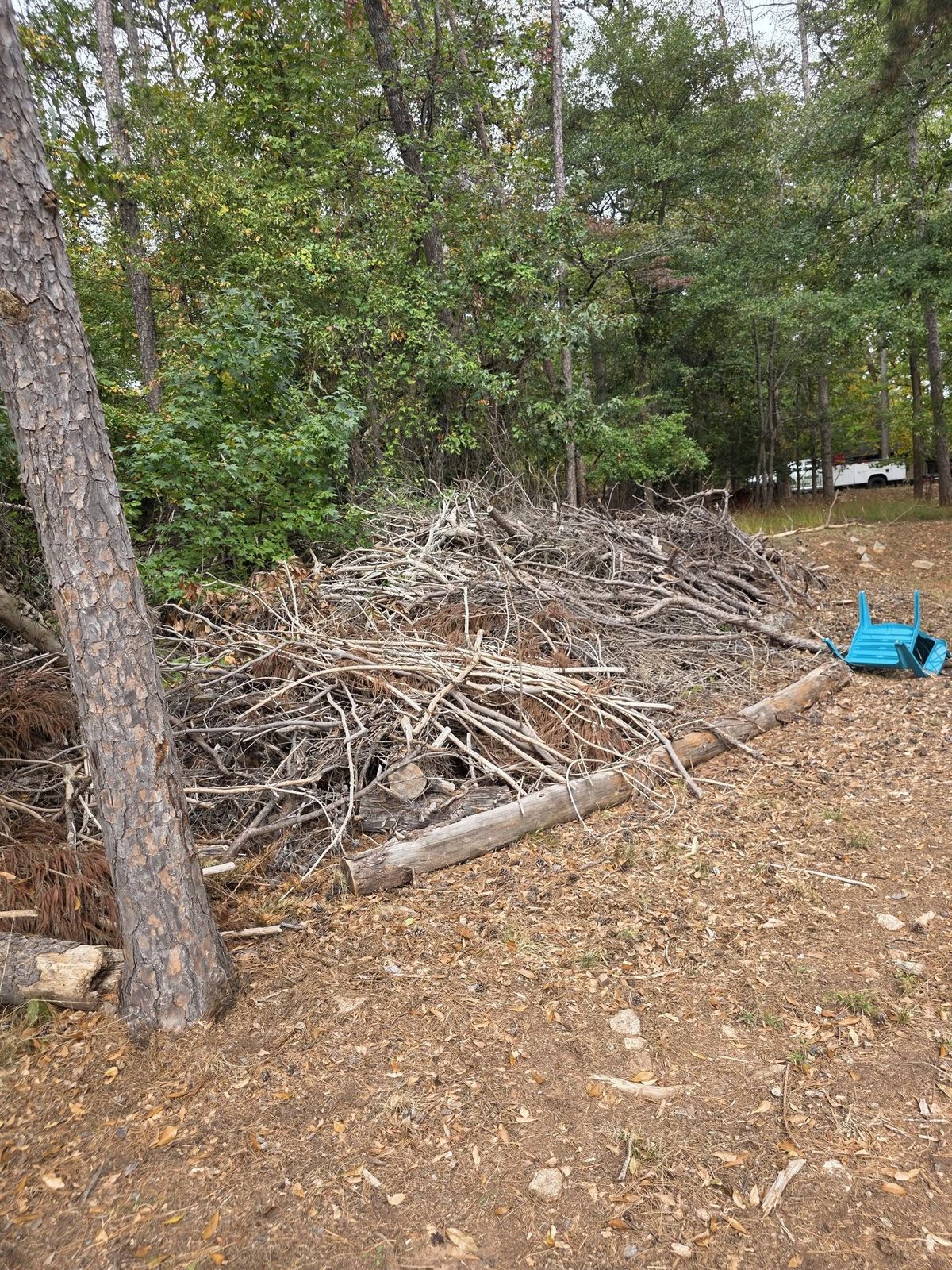
- Debris clearing and haul-out. Logs and brush move out of the immediate hazard zone. Confirm in writing that debris haul is included in scope; material left on a slope lot after a storm creates its own secondary hazard before the next rain.
- Documentation before cutting begins. Photograph the full scene from a safe distance before any cutting starts. Time-stamped photos taken before debris moves are what insurance adjusters need. The tree fell on house page walks through the insurance process step by step.
What emergency tree service costs and what moves the number
Emergency and storm work in the Upstate runs above standard removal rates. The emergency tree removal cost page breaks down pricing in full; the table below shows how scope drives range for typical Pickens County and Greenville-area conditions:
| Scenario | Typical Range (Upstate SC) |
|---|---|
| Single limb down, no structure contact, accessible lot | $500 to $900 |
| Whole tree down in yard, clear of structures | $700 to $1,500 |
| Tree contacting roof, vehicle, or fence | $1,500 to $3,000 |
| Steep slope or difficult access | Adds to any row above |
| After-hours or weekend response | Premium applies to any row above |
Depth and grade are the wildcards on foothills lots. A tree that fell cleanly onto flat lawn is a different job than one wedged against a hillside with its root plate over a retaining wall. Tree Wisemen prices every job after a free estimate within 50 miles of Easley — the ranges here are honest Upstate SC typicals, not their quote.
What to do while you wait for the crew
Keep everyone away from any tree that is leaning, partially uprooted, or touching a structure. The load on a hung-up limb can release without warning, and a root plate that looks stable can still be settling. Do not attempt to push, pull, or cut the tree yourself.
Call your homeowner's insurance carrier before work begins, not after. Photograph the scene from a safe distance — time-stamped images taken before anything moves carry significantly more weight with adjusters than photos taken after the debris is gone. Insurance typically covers removal when the tree has contacted a covered structure; it typically does not cover removing a standing hazard tree that has not yet caused damage. The specifics depend on your policy.
If the tree is in contact with overhead lines, call your utility company before calling the tree crew. The SC Forestry Commission publishes storm-damaged tree safety guidance covering secondary failure risks — a crew that starts cutting without a utility clearance creates a second emergency on top of the first one.
What to ask any crew before work starts
Not every crew showing up after a storm carries the right credentials or follows the right process. Three questions narrow the field fast:
"Are you licensed and insured in South Carolina?" Tree work above certain dollar thresholds triggers contractor licensing requirements in this state. The SC LLR Contractor Licensing Board maintains a public license lookup — check it before anyone touches the tree. Insurance matters separately: a worker injured on your property without workers' compensation coverage creates liability that lands on the homeowner.
"Can I see your liability and workers' comp certificates?" Ask for them on paper before the crew starts. Storm-chaser operations that follow disaster events into an area frequently do not carry them, and they know the window is narrow enough that most homeowners do not ask.
"What exactly does the scope include — debris, haul-out, and stump?" Stump grinding is routinely excluded from emergency pricing and scheduled as a separate job. Confirm in writing what debris haul looks like. For events that involve multiple trees or a mix of yard and fence-line work, the storm cleanup page covers scope and pricing for those larger situations.
Where emergency calls concentrate across the Upstate service area
Greenville's older residential neighborhoods carry some of the highest storm-call density in the region. Streets lined with decades-old oaks and water maples, planted when houses were new, now have mature canopies directly above rooflines. When a storm cell crosses from the foothills into the city, those trees have nowhere to fall except onto something. Lot sizes are compact and large equipment access is often limited, which pushes crews toward rigging and sectional removal rather than straightforward felling.
Pickens County's towns — Easley, Liberty, Pickens — sit closer to the foothills edge, where residential lots frequently back up to wooded acreage. Emergency calls here often involve the yard tree that fell clean alongside two or three fence-line trees now leaning toward a neighbor's property that need to come down before the next storm moves through. Those mixed-access, multi-tree situations are exactly the scope the storm cleanup page is built around — different budget, different crew choreography, different insurance documentation than a single-tree emergency.