Why slope defines every dead-tree job in Pickens County
Pickens County sits at the transition between the Upstate piedmont and the first Blue Ridge foothills, the last flat-to-rolling terrain before the land rises toward Table Rock State Park and the Jocassee Gorges. The neighborhoods in Easley, Clemson, Liberty, and Six Mile carry mature hardwoods that grew for decades before the houses were built around them: white oaks, hickories, and tulip poplars that now tower over rooflines on grades that flatten out for the driveway and climb steeply again at the back of the lot. When one of those trees dies, it rarely stands in flat, open ground. It stands on a slope, over a fence, with a utility line woven through the canopy somewhere between the trunk and the sky.
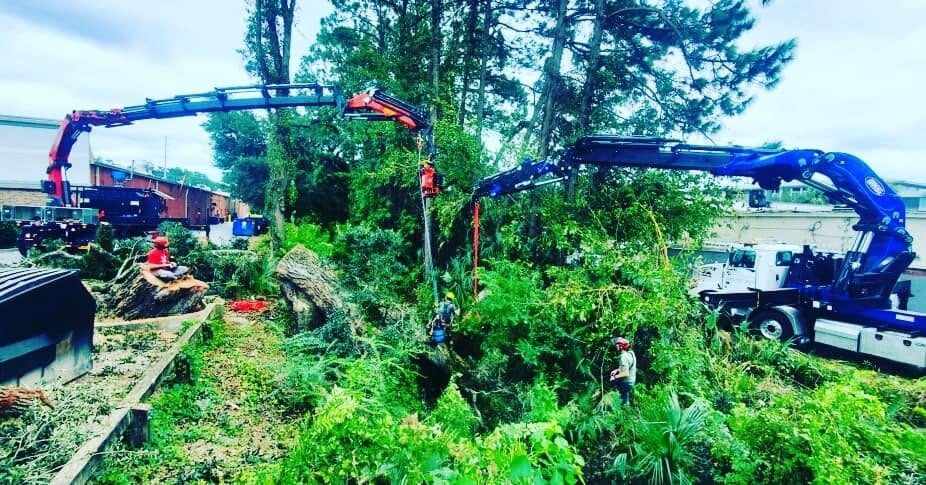
That geometry is the central fact of every job. Which limbs come off first, what fall zone is physically available on a hillside lot, whether a crane is worth deploying on a 60-foot oak behind a split-level — none of those questions have answers over the phone. They have answers when someone walks the yard. The SC Forestry Commission publishes risk-assessment guidance for homeowners that helps frame the right questions before a crew arrives, but the site answer is always specific to the ground under that tree.
What the tree is telling you before it comes down
A tree can be dead at the crown and still standing for years. It can leaf out weakly in early spring and be structurally compromised at the root flare below. Clemson Cooperative Extension identifies the failure modes most common in Upstate SC: root rot accelerated by the clay soils of the piedmont, pine beetle and drought-driven crown dieback, and mechanical failure following ice loading, which the foothills collect more heavily than the flatter counties south of Greenville. Knowing which failure mode you are dealing with changes what a qualified crew will address first.
The signs that move a tree from "watch it" to "schedule it": bark sloughing off in sheets, fungal conks at the base or root flare, a lean that has changed direction since last season, or a sizable limb that fell without a storm event. Movement without weather is structural. A scratch test on a small twig gives a first read: green tissue just under the bark means living wood, brown or dry means that branch is gone. The lower trunk and soil around the root flare are where the real condition question lives on a large specimen. If you have been watching a tree decline through two or more seasons and the decline continues, that is enough to warrant an on-site assessment.
What jobs typically cost in Upstate SC
Pickens County tree removal follows the Upstate SC cost band, with slope, canopy access, and debris haul distance pulling individual jobs up or down within it. Stump grinding is a common add-on; ask about it when requesting your estimate. The full cost breakdown covers line items in detail; the table below gives a working orientation by job scope.
| Job scope | Typical range |
|---|---|
| Small dead tree, under 30 ft, open access | $300–$600 |
| Medium tree, 30–60 ft, standard residential lot | $600–$1,200 |
| Large tree, over 60 ft, good access | $1,200–$2,000 |
| Crane or technical rigging required | Priced on-site; can exceed $3,000 |
| Emergency response, active hazard | Priced on-site |
Steep-lot jobs on foothills terrain routinely carry line items that flatland quotes never show: rigging hardware, potential crane time, and debris handling down a grade. Any bid that does not account for slope on a Pickens County hillside lot should be treated as incomplete rather than a bargain.
Permits, liability, and when neighbors are part of the equation
South Carolina does not require a statewide permit to remove a tree on private residential property, but that is not the full answer. Utility easements, HOA covenants, and municipal tree ordinances can each impose their own requirements depending on where in Pickens County the property sits. If the tree is on or near a shared property line, the neighbor's written acknowledgment can prevent a future dispute regardless of what any ordinance requires. The specifics by jurisdiction are covered at the SC permit guide; check there before scheduling if your tree is near a property line or a utility easement.
Liability tends to be the more pressing concern on most jobs. A dead tree that falls on a neighbor's structure raises a coverage question your insurer will evaluate partly on this: was the hazard known and unaddressed? A documented assessment, even one that concludes "monitor it another season," creates the record that an undocumented situation cannot provide. The crew you hire should carry general liability and workers' compensation; licensing for tree and landscaping contractors in South Carolina sits with the SC LLR Contractor Licensing Board, and asking for proof before work starts is standard practice.
The storm record and why a known hazard cannot wait
Pickens County carries a documented storm record (23 federal disaster declarations across 2005-2026), and the foothills geography means the county sees ice loading, high wind, and storm damage at a higher rate than the flat Upstate counties to the south. A large dead hardwood on a slope with a utility line above it is a different risk profile from the same tree in an open field. Dead wood becomes structurally unpredictable once the vascular system shuts down, and the foothills' combination of ice, wind, and saturated soils after heavy rain creates the conditions where unpredictable trees become urgent problems. The window between "visibly declining" and "on the ground" is shorter than most homeowners expect, and faster for pines than for hardwoods.
Emergency tree removal after a storm event, whether a trunk is against a structure or a split leader is leaning toward the house, prices differently from scheduled dry-weather work. Getting ahead of a known hazard is almost always less expensive than responding to it after the fact. If the tree in question has changed condition visibly in the past 60 days, that is the right timeline for a free estimate, not the following season.