When clay soil lets go
Pickens County sits where the Blue Ridge foothills flatten into the Upstate's creek-cut piedmont, and the heavy red clay soils running through that transition zone change how tree emergencies play out here. During a hard summer thunderstorm or the ice events that push through every few winters, saturated clay gives up its grip from the top down. A tree that looked solid on a dry ridge can uproot fully by midnight — bringing a dense rootball, a compressed soil mass, and whatever it leans against into the picture at once.
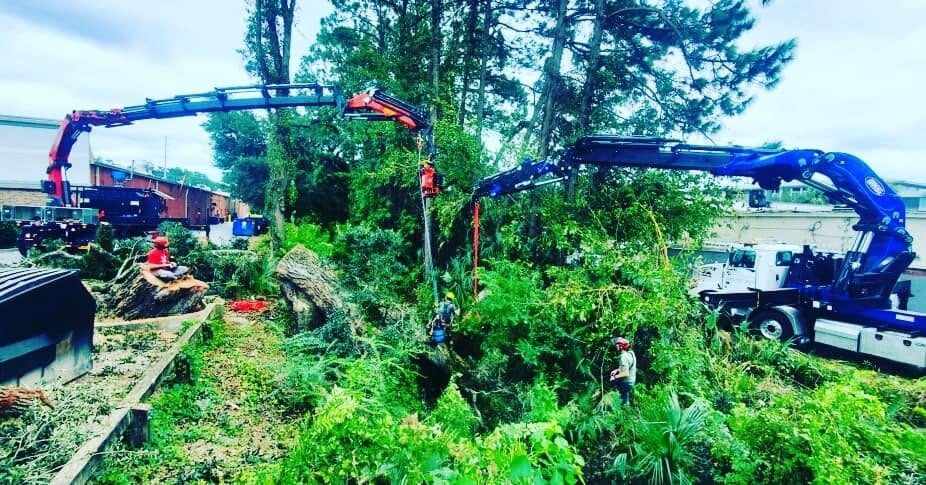
That is a different job than a snapped top. A clean break can usually be felled away from the structure it threatens; an uprooted tree cannot. Crews must rig, section from the top down, and work around the fulcrum of the rootball. On a lot with a ravine out back or a slope that blocks straight truck access — both common throughout the foothills running from Easley toward the Table Rock area — the job picks up equipment time before the first cut is made.
Federal disaster history backs up the storm frequency: 23 federal disaster declarations have touched this part of South Carolina over 2005-2026, most of them severe weather events. That pattern is why emergency tree crews in this county build around-the-clock capacity, and why that capacity is priced into the call even when your tree comes down on a weekday afternoon.
What Upstate SC homeowners pay
National cost guides are written for the median job: flat lot, easy truck access, pine-country debris. The Upstate is not that. Foothills topography, clay rootballs, and the mix of fast-growing loblolly pine and dense hardwood all widen the spread on what an emergency job costs here. The figures below reflect emergency-rate work in the Greenville and Pickens County area; they are ranges, not quotes, and the reason for the spread is usually visible the moment a crew sets foot on the lot.
| Job scope | Typical Upstate SC range | What drives it |
|---|---|---|
| Downed tree, clear access, daytime | $500 – $900 | size, whether debris is hauled or left |
| Storm-damaged tree with structure contact | $800 – $1,800 | rigging required, rootball size, slope |
| Hazard tree leaning on fence or driveway | $900 – $1,800 | access, piece count, soil condition |
| Large tree on roof or touching utility lines | $1,800 – $3,000 | aerial equipment, after-hours rate, coordination required |
These ranges include the emergency premium — the cost of a crew ready to respond at any hour. Standard removal of the same tree on a clear afternoon would sit noticeably lower. If a bidder comes in far outside these ranges without walking you through why, how they explain it tells you as much as the number does.
What the emergency rate actually covers
An after-hours call is not a rushed standard removal. Emergency pricing pays for crew availability around the clock, equipment staged and ready to run, and the judgment calls that come with experience: working near a live span, stabilizing a rootball that has not finished moving, sectioning a tree that is holding up part of a roof. That last scenario has its own sequence of decisions — our tree-fell-on-house guide covers what to do before you authorize the first cut when a structure is involved.
Storm-pattern timing matters in this county. The NOAA National Weather Service Greenville-Spartanburg forecast area regularly issues severe thunderstorm and tornado watches during spring and late summer, when afternoon convection builds quickly off the mountains. When multiple properties across Pickens and Greenville counties come down in the same storm track, every emergency crew's dispatch board fills at once. Crews that invested in after-hours capacity fill those calls first, and that investment is reflected in their rate year-round.
One thing the emergency rate does not cover: utility line contact. If a tree has pulled down or made contact with a power line, call your utility company before dispatching any tree crew. Crews cannot legally clear work from an energized line, and waiting for the utility to cut and de-energize is not a delay — it is the only safe sequence.
Licensing and who does this work in South Carolina
South Carolina does not issue a dedicated tree contractor license, but legitimate emergency crews carry general liability insurance and workers' compensation coverage. For arborists who want to demonstrate professional standing, industry certifications signal training in hazardous-tree assessment and rigging techniques. The practical baseline: ask for a certificate of insurance before work begins. A crew that waives that request is not saving you a step — they are transferring their risk to your property.
When an emergency job bundles tree removal with structural repair — tarping a roof, boarding a window — that work can cross into general contractor territory. The SC LLR Contractor Licensing Board regulates general contracting above South Carolina's licensing threshold. Post-storm, unlicensed contractors following the damage track into affected neighborhoods are a documented pattern statewide; the emergency does not suspend the licensing rules. Verifying any contractor's license status at the LLR website before signing anything takes ten minutes and eliminates significant exposure.
The SC Forestry Commission publishes professional standards for tree care work in South Carolina, including guidance on hazardous-tree assessment and emergency response protocols. Their resources are written for practitioners but accessible to homeowners who want to understand what a qualified crew should be doing during a hazard call.
Before the cleanup crew arrives
The documentation window closes fast. Once a storm tree is sectioned and hauled, the evidence an insurance carrier needs to process a claim — rootball condition, point of failure, structural contact — is gone. Before calling a crew, photograph the scene from multiple angles: the base of the tree, the direction of fall, any contact with structures, and the crown footprint. Date and time are embedded in phone photos automatically, and that timestamp matters when filing a claim.
Standard homeowner policies in South Carolina often cover removal of a tree that has fallen on a covered structure, subject to the deductible. They rarely cover a tree that fell in the yard without hitting anything. Our full breakdown of what homeowners insurance covers for tree removal walks through the typical inclusions and exclusions in SC policies and what documentation to gather before an adjuster visits.
When you are ready to call, our emergency tree service page covers what to expect from that first call: service area, what information to have ready, and how estimates work when a site cannot be fully assessed until the crew is on the ground.
How to protect the price on an emergency call
Emergency calls come with more information asymmetry than standard removals — the situation is stressful, the hour may be inconvenient, and you need a crew quickly. A few moves keep the number honest without slowing down the response:
- Get a scope, not just a price. Ask what the quote includes: cutting, rigging, stump at grade or below grade, haul-off, or debris left for you to handle. The variables in the table above are real; a low number that excludes haul-off and stump grinding will grow.
- Confirm insurance before the first cut. A certificate of insurance naming you as an additional insured for work on your property takes a few minutes to verify and matters considerably if something goes wrong during a rigging job on a Upstate slope.
- Do not authorize removal before you have documented. If a structure is involved, your insurance carrier may need photos, an adjuster visit, or a written assessment before you sign for removal. Some policies have explicit documentation requirements — the tree-fell-on-house guide lays out the full sequence when that is the case.
Getting multiple quotes during an active emergency is not always realistic, but knowing the Upstate SC range going in means you can recognize a number that needs an explanation, even when the clock is running.